
A global payments network · 2018–2020
One boarding flow for every merchant
Led UX for enterprise merchant boarding, shipping a save-as-you-go flow that reduced abandoned sign-ups, then designed a single conversational flow to bring small businesses onto the same platform.
Names, figures and screens have been changed or recreated to respect a confidentiality agreement. The process and decisions are as they happened.
The problem
The company sold payment acceptance to merchants of every size through two separate products. Enterprise merchants, global brands with thousands of locations, were boarded on one platform, usually by an administrator at a reseller working on the merchant’s behalf, or by the company’s own staff acting as the reseller. Small businesses signed up through a separately branded gateway the company also owned.
Both products did essentially the same job, which meant two systems to maintain and two experiences to improve. The goal was a single platform. The design problem was that the two groups of people who would use it could hardly have been more different.
Two very different users
| Enterprise | Small business | |
|---|---|---|
| Who boards | An admin at a reseller, or company staff acting as the reseller | The business owner |
| How often | Several times a day | Once |
| What they know | Expert in the process and its terms | New to all of it |
| What they need | Speed, shortcuts, control over complex setups | Guidance, plain language, confidence |
A reseller admin wants density and shortcuts. A business owner needs to be walked through terms they’ve never seen. Anything that helps one group risks getting in the way of the other.
Boarding was also where merchants signed up for products, and some of those products belonged to other designers. Keeping the flow coherent meant coordinating with them so their pieces plugged in correctly.
What shipped: a hub instead of a tunnel
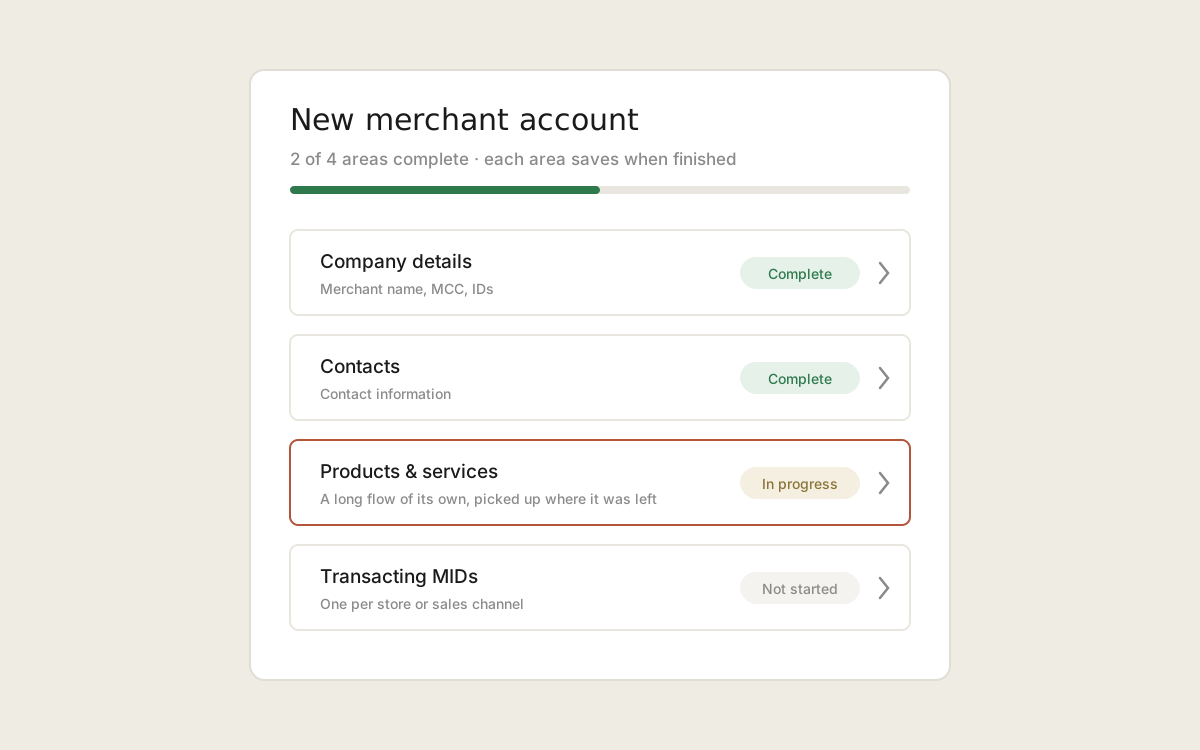
Enterprise boarding was long, and some parts of it were long flows in their own right. Asking someone to get through all of it in one sitting was risky: a server error at the last step could wipe out an hour of work.
I restructured it as a hub with spokes. The hub page lists each area of the setup and its status. Each area opens into its own flow and is saved as soon as it’s finished, so an admin can complete one area, leave, and pick up exactly where they stopped.
The same decision solved an engineering problem. Saving area by area replaced one enormous submission at the end, which reduced the number of server calls hitting the system at once.
From 2020 through 2025 I kept extending the flow as new products and services were added to what merchants could sign up for during boarding.
The vision: one conversation, two paths
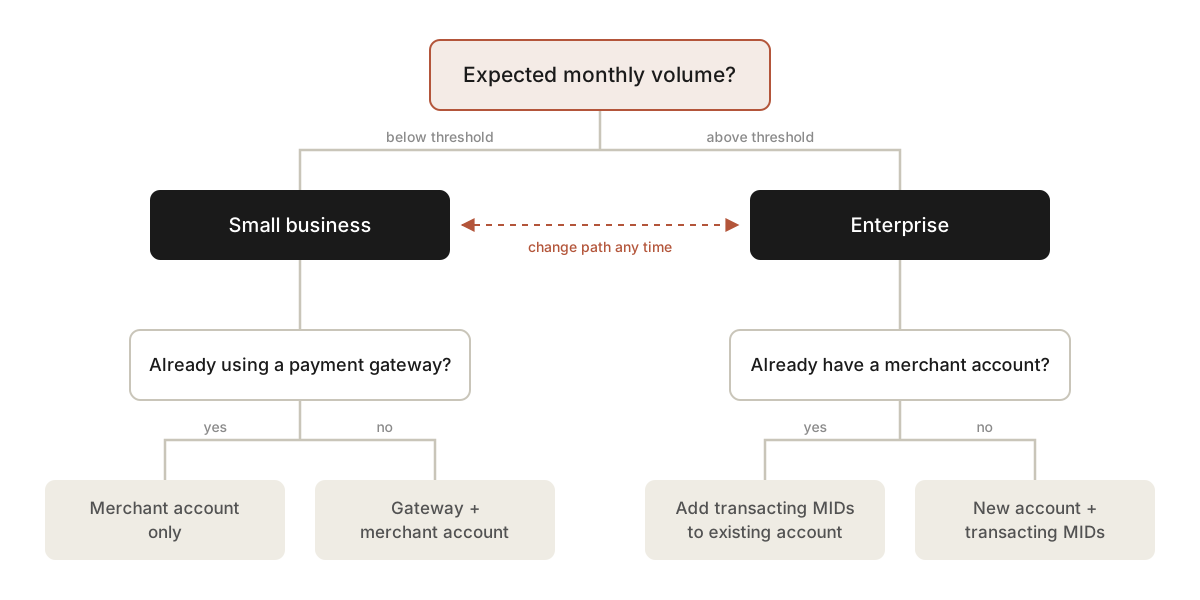
For the unified platform, I designed a conversational flow that guides each merchant down the right path and keeps the difference between paths invisible to anyone it doesn’t affect.
It starts with one question every business can answer: expected monthly volume. Above a threshold, the merchant goes down the enterprise path; below it, the small business path. Nobody has to decide whether they count as “enterprise,” and the answer can be changed at any time, so someone who types a few extra zeros isn’t stuck on the wrong path.
The next question on both paths asks the same thing: what do you already have? A small business that already uses a payment gateway only needs a merchant account; one that doesn’t gets both. An enterprise that already has a merchant account only adds transacting MIDs (one merchant ID per store or sales channel), while a new one creates the account first.
Don’t ask for what you already know
A new account needs the basics: merchant name, contact information, merchant category code, IDs. A MID added to an existing account needs the same information, but it inherits it from the parent account, filled in and read-only unless the admin chooses to change it.
The admin only touches what’s actually different, such as a store’s address, and can’t accidentally change a company’s category code while adding its fortieth location.
Outcome
The hub-and-spoke flow shipped, and feedback was positive: fewer abandoned boardings, and in qualitative research users said they appreciated the changes and the shortcuts. TODO: add a number if you have one, even a relative one.
The unified flow for small businesses and enterprises was not built. TODO: one sentence on why, e.g. “the project ended before we got there.”
What I’d do differently
We built support for complex organizational structures, aimed mainly at merchants the size of a global luxury conglomerate. About 99% of users ignored it, and it added complexity for all of them. I’d now keep a feature like that out of the main path and bring it up only for the merchants who need it.
The bigger gap was volume. An admin adding 100 locations still had to go through the process 100 times.
Where it was heading
Two things were next. The first was bulk creation: “I need a new merchant account with 150 transacting MIDs that share this information,” done in one step and not 150 runs through the flow.
The second was moving every part of setup that isn’t required for boarding out of the boarding flow and into the merchant’s first login, so they could clear the hurdle of boarding and finish the rest as they started using the product.